
Breast Health Beyond the Mammogram: A Guide to Screening and Proactive Breast Health
By Kristin Brien APRN, FNP-BC, IFMCP-M and founder of The Mend Wellness, a virtual functional and lifestyle medicine practice for women in New York and Connecticut. Last reviewed October 16, 2026.
Proactive breast health means combining appropriate breast cancer screening with a personal risk assessment, an understanding of breast density, evidence-based lifestyle choices, and individualized hormone therapy decisions.
October is Breast Cancer Awareness Month, and the familiar reminder is important: schedule your mammogram. But the conversation deserves to go further.
Do you have dense breasts? Does your family history change your screening needs? Would additional imaging help? And if you are considering hormone replacement therapy (HRT), what does the evidence actually say about breast cancer risk?
These questions help turn a routine screening appointment into a more personalized breast health plan.
When should you start mammograms, and how often?
Several major U.S. organizations recommend starting screening mammograms at age 40 for women at average risk, although their recommendations differ on frequency.
U.S. Preventive Services Task Force (USPSTF): Every two years from ages 40 through 74.
American College of Obstetricians and Gynecologists (ACOG): Every one to two years beginning at 40, using shared decision-making.
American College of Radiology (ACR): Every year beginning at 40, with breast cancer risk assessment by age 25 to identify women who need earlier screening.
Your screening plan may differ if you have a hereditary cancer predisposition, prior chest radiation, a personal history of breast cancer, or certain high-risk breast biopsy findings. Screening after age 74 also requires an individualized discussion.
The goal is to choose a schedule that reflects your age, health, personal risk, and preferences.
What is breast density, and why does it matter?
Breast density describes the amount of fibrous and glandular tissue compared with fatty tissue on a mammogram. Dense breasts can increase breast cancer risk and make cancer harder to detect.
Density cannot be determined by breast size, firmness, or how your breasts feel. Radiologists describe it using four categories:
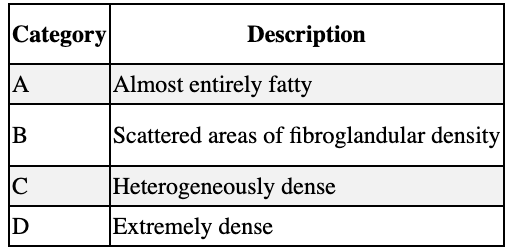
Categories C and D are considered dense. Dense breast tissue is common and is not an abnormal diagnosis. However, both dense tissue and many cancers appear white on a mammogram, which can make a cancer harder
to see.
How do you find out your breast density?
Since September 10, 2024, mammography facilities subject to FDA requirements must tell patients whether their breasts are dense or not dense. The report sent to your healthcare provider includes the density assessment.
If your results letter does not include your specific category, ask for the full radiology report.
Do you need an ultrasound or MRI if you have dense breasts?
Possibly. The decision depends on your breast density, overall breast cancer risk, and the benefits and limitations of additional testing.
The ACR recommends breast MRI for women with dense breasts who desire supplemental screening. It also recommends MRI for specified higher-risk groups, including women with certain genetic risks or a calculated lifetime breast cancer risk of at least 20%. Contrast-enhanced mammography or ultrasound may be alternatives when MRI is not appropriate or available.
The USPSTF concludes that evidence is insufficient to determine the balance of benefits and harms of supplemental ultrasound or MRI after a negative mammogram in women with dense breasts. That is an evidence gap, rather than a recommendation against additional imaging.
Additional testing can detect cancers missed by mammography, but it can also lead to false alarms, follow-up imaging, and biopsies that do not find cancer. It’s important to discuss these tradeoffs with your provider.
What if I’m scared of mammograms? Can I get a breast ultrasound or MRI instead?
For most women, breast ultrasound or MRI supplements a screening mammogram rather than replacing it. Each test detects different findings. Mammograms can reveal tiny calcium deposits called microcalcifications, which may signal early breast cancer and may not be reliably identified by ultrasound or MRI.
If fear, pain, or a difficult past experience is keeping you from scheduling or choose to decline mammography, work with your provider and a breast imaging specialist to discuss an individualized approach. Ask what an alternative test can detect, what it may miss, and whether it is appropriate for your risk level.
Which breast changes need evaluation between mammograms, breast MRI or breast ultrasound?
A new breast change deserves evaluation even if your most recent mammogram was normal.
Contact your healthcare provider about:
A new lump in the breast or underarm.
New nipple inversion or discharge, particularly bloody discharge.
Skin dimpling, thickening, persistent redness, or swelling.
A new change in breast shape or size.
Persistent pain in one specific area.
Many breast changes have benign causes. Still, symptoms may require an examination and diagnostic imaging rather than waiting for your next screening mammogram.
Which breast cancer risk factors can you change?
Alcohol intake, physical activity, and excess body weight after menopause are important modifiable breast cancer risk factors.
Other factors including: age, inherited genetic variants, family history, environmental exposures, breast density, and reproductive history help establish your underlying risk. A healthy lifestyle does not eliminate that risk, and developing breast cancer is never evidence that someone failed to take care of herself.
The most useful changes are practical and sustainable:
Reduce alcohol. Breast cancer risk increases with alcohol consumption. Drinking less, or choosing not to drink, can reduce your exposure to this risk factor.
Move regularly. Physical activity is associated with lower breast cancer risk.
Support a healthy weight after menopause. Excess visceral fat is associated with increased postmenopausal breast cancer risk.
Recognize breastfeeding as one protective factor. Breastfeeding is associated with lower risk, although it is not possible or appropriate for everyone.
For women at substantially elevated risk, prevention may also include discussions about risk-reducing medication or surgery with a specialist. Lifestyle changes complement these options.
Can food, vitamin D, or supplements prevent breast cancer?
There is no single food that prevents breast cancer. But dietary patterns matter. However, healthy eating habits built around whole foods, vegetables, fruits, legumes, lean protein, and other nutrient-dense foods supports overall health and weight management. Cruciferous vegetables like broccoli, cauliflower, and Brussels sprouts contain compounds that support healthy estrogen metabolism. Omega-3 fatty acids from fish, walnuts, and flaxseed help lower inflammation levels.
On the other side, ultra-processed foods contribute to chronic inflammation. Endocrine disruptors found in certain plastics and personal care products can interfere with hormonal signaling over time. You don't need to overhaul your life overnight. But knowing where targeted changes can support your body's protective systems gives you more agency than most awareness campaigns offer.
Vitamin D levels, frequently low and rarely checked or properly replaced, have been linked to breast cancer outcomes in multiple studies.
What should a proactive breast health plan include?
Follow a screening schedule appropriate for your age and risk.
Know your breast density and whether supplemental imaging is worth discussing.
Review your personal and family history, including whether genetic counseling or formal risk assessment is appropriate.
Report new breast changes promptly, even after normal screening.
Focus on evidence-based habits, especially alcohol reduction, regular movement, and weight management after menopause.
Individualize menopause treatment, with periodic review of benefits, risks, and preferences.
Proactive breast health means knowing your breast density and what it means for your screening plan. It means understanding your individual risk factors, both the ones you carry and the ones you can influence. It means making nutrition and lifestyle choices that support your body's protective capacity. And it means having the conversations that matter, about screening, about risk, and about what your body actually needs during perimenopause and menopause.
If you've been navigating menopause symptoms without exploring your hormone therapy options, or if you've avoided the conversation because of breast cancer concerns, this is a good time to revisit it with a healthcare provider who can walk through the evidence with you and assess your individual risk.
Schedule a consultation to discuss your hormone health options, review your personal risk profile, and build a plan that reflects where your body is right now.
This article provides general education and does not replace individualized medical advice. Discuss breast symptoms, screening, and treatment decisions with your healthcare provider.
